Table of Contents
Dubai is one of the fastest-growing real estate markets in the world. For anyone planning to buy property in the city, understanding the Dubai real estate map is essential.
The city is not just one central area. Dubai is made up of multiple communities, each offering a different lifestyle, price point, and investment opportunity. Some areas are fully established and highly sought after, while others are still developing and may offer stronger long-term growth.
In this guide, we break down the main areas of Dubai, explain how the city is structured, and highlight the best places to consider for property investment.
Why Understanding the Dubai real estate Map Matters
If you want to invest in Dubai property, you need to know more than just the name of a new project. You need to understand where it sits in the wider city, what infrastructure supports it, and how that location may perform over time.
Dubai has expanded rapidly since the freehold market opened in 2002. What was once a smaller city concentrated around Deira and Bur Dubai has grown into a major global hub with multiple residential, commercial, and lifestyle districts.
Today, living in Dubai Creek Harbour offers a very different lifestyle from living in Dubai Marina, JVC, or Dubai Hills Estate. That is why location plays such a major role in real estate performance.
How Dubai Has Grown Since 2002
Dubai’s real estate growth has been exceptional. In 2002, much of the city was concentrated in the north, especially around Deira and Bur Dubai.
Since then, Dubai has expanded southward and outward into the desert, creating new residential communities, business districts, shopping destinations, and infrastructure corridors. Compared with older global cities, Dubai’s pace of development has been unusually fast.
This growth is one of the main reasons many investors see Dubai as an attractive real estate market. The city continues to evolve, and new communities are still being developed in strategic locations.
Dubai Zones Explained
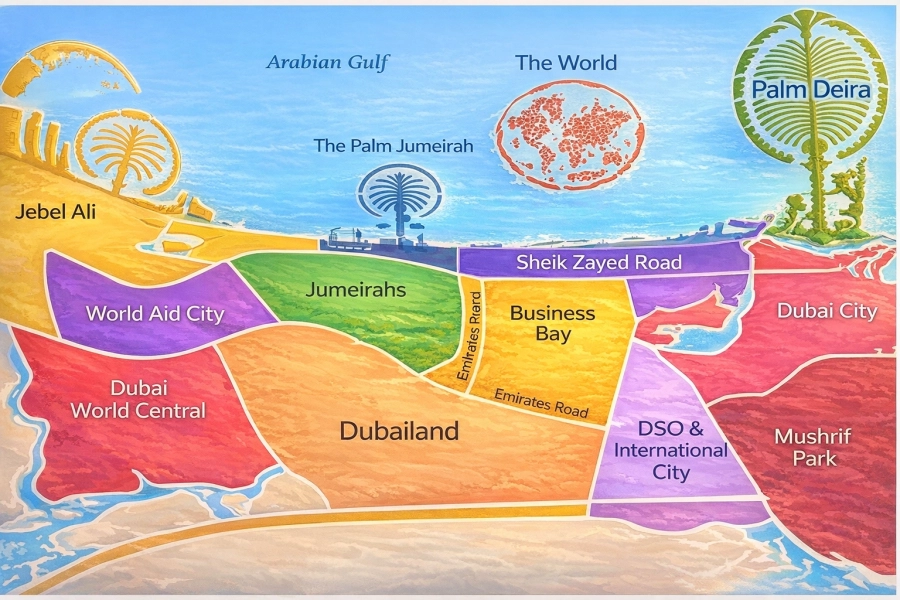
A simple way to understand Dubai is through its major road network. These roads form the structure of the city and help explain which areas are central and which are further out.
The key roads include:
- Sheikh Zayed Road
- Sheikh Mohammed Bin Zayed Road (E311)
- Emirates Road (E611)
- Al Ain Road
In practical terms, many people think of Dubai in informal zones. Sheikh Zayed Road is often considered the most central part of Dubai, while areas beyond Emirates Road are seen as outer zones with lower entry prices and future growth potential.
Old Dubai: Deira and Bur Dubai
The original center of Dubai was in Deira and Bur Dubai. These areas were the foundation of the city and remain important today for trade, business, and local culture.
Dubai International Airport is also located near this part of the city, reinforcing its historical importance. However, modern Dubai has expanded far beyond these traditional districts.
The Two Main City Centers in Dubai
Dubai does not have just one city center. Instead, it has two major hubs that attract residents, tourists, and investors.
1. Downtown Dubai, Business Bay, and DIFC
This part of Dubai is the business and financial core of the city. It includes:
- Downtown Dubai
- Business Bay
- DIFC
This district is home to the Burj Khalifa, major office towers, luxury residences, and some of the most prestigious addresses in Dubai. For many investors, this is one of the safest and strongest areas for premium real estate.
2. Dubai Marina, JLT, and Palm Jumeirah
The second main center includes:
- Dubai Marina
- Jumeirah Lake Towers
- Palm Jumeirah
This area is more lifestyle-driven and especially popular for waterfront living, holiday homes, and short-term rental investment. It benefits from beach access, strong tourism demand, and a vibrant residential environment.
Best Central Communities for Dubai Property Investment
Between Downtown and Dubai Marina, there are several important residential areas that investors should know.
Al Barsha and Emirates Living
Al Barsha is a large residential area, though much of it is not available for freehold purchase for international buyers.
Nearby is Emirates Living, one of Dubai’s best-known villa and townhouse zones. It includes communities such as:
- Emirates Hills
- The Meadows
- The Lakes
- The Springs
These are established family communities with strong demand, especially among long-term residents.
District One
For buyers who want villas close to Downtown Dubai, District One is one of the key areas to consider. Known for its luxury positioning and Crystal Lagoons, it has become one of the city’s standout upscale communities.
Central Suburbs in Dubai
As Dubai expanded, a wide range of suburban communities emerged. These areas are highly relevant for investors because they often combine affordability with strong rental demand.
Popular central suburbs include:
- JVC
- JVT
- Arjan
- Town Square
- Mira
- Mira Oasis
JVC is especially popular for apartments, while JVT offers more townhouses and villas. Town Square has a mix of apartments and townhouses, making it attractive to both investors and end-users.
These communities are often chosen by buyers looking for better value compared with Downtown or Marina.
Best Villa and Townhouse Areas in Dubai
Between E311 and E611, there is a large concentration of villa and townhouse communities.
Important areas include:
- Arabian Ranches
- Arabian Ranches 2
- Arabian Ranches 3
- Villanova
- The Villa
- Haven
- Athlon
- The Acres
These communities are popular with families who want more space, privacy, and a suburban environment. They are also increasingly attractive to investors focused on end-user demand rather than just short-term speculation.
Al Barari
Al Barari stands out because of its greenery and unique design. In a desert city, its lush landscaping gives it a distinctive identity. It is mainly villa-focused, with some apartment options as well.
Dubai Hills Estate: One of the Top Investment Areas in Dubai
Dubai Hills Estate is one of the most important communities in Dubai real estate today.
Developed by Emaar, it offers a combination of villas, townhouses, and apartments. It also includes a golf course and Dubai Hills Mall, which has become one of the city’s most popular retail destinations.
Because of its central location, strong developer reputation, and growing infrastructure, Dubai Hills Estate is widely seen as one of the best areas to invest in Dubai property.
Affordable Areas to Invest in Dubai
Investors with a lower budget often look beyond the central zones to areas with lower entry prices and higher future upside.
Two notable examples are:
- The Valley
- DAMAC Hills 2
These communities were once considered too far from the city, but Dubai’s expansion is changing that perception. As infrastructure improves and more residents move outward, these locations may benefit from long-term capital growth.
Dubai South: A Major Future Growth Area
Dubai South is one of the most important long-term investment zones in the city.
It is expected to benefit from the expansion of Al Maktoum International Airport, which is planned to become a major global aviation hub. This alone makes the area highly strategic.
Key areas within or near Dubai South include:
- Expo City Dubai
- Dubai South Residential District
- Emaar South
- Hayat
For investors looking to enter emerging areas early, Dubai South is one of the strongest locations to watch.
Expo City Dubai and Future Infrastructure
Expo City is expected to become a major urban and business center in the future. As more infrastructure and residential development come online, the area may become one of Dubai’s next major hotspots.
Infrastructure is one of the biggest drivers of property values in Dubai. Investors who understand future transport links, airport expansion, and master-planned growth areas are often better positioned to identify opportunities early.
Palm Jebel Ali: Dubai’s Next Big Waterfront Investment Opportunity
Palm Jumeirah is already established and expensive. Palm Jebel Ali, on the other hand, is still in its early stages and offers a different investment profile.
Palm Jebel Ali is larger than Palm Jumeirah and is expected to include new villas and apartments over the coming years. Because it is still being launched, many investors see it as a chance to enter Dubai’s waterfront market before values mature.
For buyers focused on long-term capital appreciation, Palm Jebel Ali is one of the most talked-about new areas in Dubai real estate.
Freehold Areas in Dubai
One of the most important questions international buyers ask is whether they can buy freehold property in Dubai.
The answer is yes, but only in designated freehold areas. Not every part of Dubai is available for freehold ownership by non-GCC buyers.
This is especially important in prime coastal areas such as Jumeirah, where some land is not available for freehold purchase. As a result, freehold waterfront communities can be especially valuable due to limited supply.
Master Communities vs Multi-Developer Communities
When buying property in Dubai, it is also useful to understand the difference between master communities and multi-developer communities.
A master community is usually planned and developed under one overall vision, often by a major developer. These communities tend to have a more unified design and stronger overall planning.
A multi-developer community allows different developers to build within the same area. This can create more variety in pricing and product type, but sometimes with less consistency.
Both can work well for investors, but the right choice depends on your goals.
Dubai Metro and Future Transport Links
Dubai’s metro system is useful, but it does not cover the entire city. Most of the current network runs along Sheikh Zayed Road and through older parts of Dubai.
The existing lines are:
- Red Line
- Green Line
The confirmed future expansion is the Blue Line, which will improve connectivity toward older districts and Academic City.
Dubai is also expected to benefit from Etihad Rail, a broader rail network connecting the UAE and potentially the wider GCC region in the future.
For property investors, transport infrastructure can be a key driver of future value.
Dubai 2040 Master Plan and Real Estate Growth
Dubai’s growth is not random. It is shaped by long-term government planning.
The Dubai 2040 Urban Master Plan outlines where future expansion, infrastructure, and population growth are expected to be concentrated. Areas such as Dubai South are gaining attention because they align with that long-term strategy.
For investors, this is a major advantage. It means that understanding government planning can help identify areas with stronger future potential.
Final Thoughts on the Best Areas to Invest in Dubai
Dubai offers a wide range of real estate opportunities, from luxury central districts to affordable outer communities with future upside.
Some of the most established and high-demand areas include Downtown Dubai, Business Bay, Dubai Marina, Palm Jumeirah, Emirates Living, and Dubai Hills Estate. For investors looking for future growth, Dubai South, Expo City, The Valley, DAMAC Hills 2, and Palm Jebel Ali are all worth watching.
The best investment area in Dubai depends on your budget, strategy, and timeline. But one thing is clear: understanding the Dubai map, its communities, and its infrastructure is one of the smartest steps any buyer can take.